
News › Back Office & Operations Hub › Legal, Compliance & Governance Tech › Analysis
ANALYSIS · LEGAL, COMPLIANCE & GOVERNANCE TECH
Data Protection Regulator Awaits the President's Decision: What Companies Should Prepare Four Years After the Law
Komdigi says the draft presidential regulation to establish Indonesia's personal data protection (PDP) supervisory agency has reached its final stage and been submitted to the President. Until the agency exists, oversight stays with Komdigi, so companies face a transition period in which the referee will change.
VRI B2B Tech Asia Review editors · 18 November 2026, 07:30 WIB · 4 min read
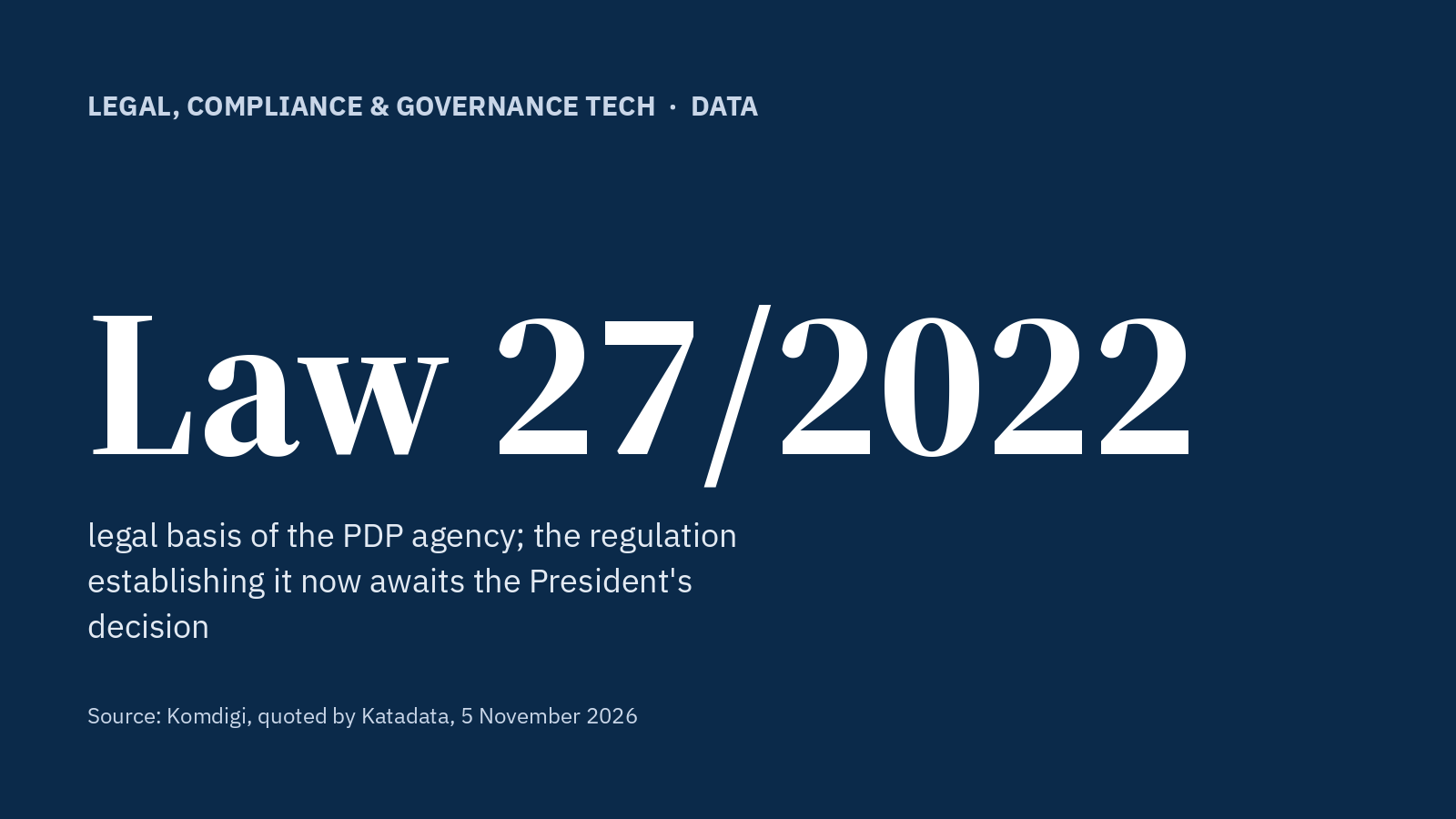
Graphic: VRI B2B Tech Asia Review. Data: Komdigi, quoted by Katadata, 5 November 2026.
NEWS IN BRIEF
Compiled from media reports. Direct quotes are marked and sources are listed.
• Komdigi stated on 4 November 2026 that the draft presidential regulation establishing the PDP agency has reached its final stage and been submitted to the President through the State Secretariat. The statement came from Muchtarul Huda, Director of Digital Space Strategy and Supervision Policy. (Katadata, Telset)
• Komdigi has set up a special task force to manage the transition and performs PDP functions until the agency is formally established. The government targets completion in 2026. (Katadata, Telset)
• The agency is mandated by Law 27/2022 on PDP. Its duties include policy-making, receiving complaints, supervision, examinations, administrative enforcement and facilitating out-of-court dispute resolution, as well as assessing whether cross-border data transfers meet requirements. (Katadata)
• Drafting began in late 2022, the presidential initiative permit was issued on 4 March 2025, and harmonization ran from October 2025 to February 2026. (Telset)
BEHIND THE NEWS
The rules apply, but the referee does not yet exist
According to IDXChannel, the PDP Law's transition period ended in October 2024, and the law provides for administrative fines of up to 2% of annual revenue and a duty to report incidents within 72 hours. Company obligations are therefore already running, while the independent agency the law envisions has not been formed. In the gap, Komdigi performs the function, and a transition task force is intended to keep incident handling uninterrupted. From a company's viewpoint, the main uncertainty is not the content of the obligations but who will assess them, under what procedures, and when.
What remains unclear: reporting line and powers
Sources differ on the agency's position. Telset says the agency will be independent and report directly to the President, not to a ministry. Katadata quotes Komdigi Deputy Minister Nezar Patria on 21 July saying the agency works independently, but its reports go to the President through Komdigi. The difference matters for perceived independence and will only be settled when the regulation's text is published. The sources we read also do not describe derivative sanction structures, budget or headcount.
After the regulation: two phases, not one
Telset explains that work after enactment runs in two phases: formal establishment of the agency, then operational setup such as staffing, office location and budget. This probably means full enforcement will not be felt the day after the regulation is issued. Even so, companies should not treat the gap as leniency, because the law's obligations already apply. We also found no announcement that the regulation has been enacted in our searches up to the time of writing; its status should be rechecked against official sources.
A new role relevant to business
The agency's duties include assessing whether cross-border personal data transfers meet requirements and cooperating with foreign PDP authorities. For companies using cloud, CRM or analytics services abroad, this suggests that documentation of the legal basis for transfers is likely to become a subject of examination.
WHAT IT MEANS FOR YOU
For Legal, Compliance and data protection officers
1. Update the register of personal data processing and the legal basis for each activity, so you are ready if the new agency asks for evidence.
2. Document every cross-border data transfer along with the provider and location.
3. Test the 72-hour incident reporting procedure, including who is authorized to report and to whom during the transition.
For CIOs and CISOs
1. Map the systems that hold personal data (cloud, CRM, analytics, vendors) and make sure access logs can be audited.
2. Review third-party processor contracts so PDP obligations and incident notification duties are written down clearly.
For compliance technology vendors
Demand is likely to rise for data mapping, cross-border transfer records and incident management. Wait for the regulation's text before claiming alignment with the new agency.
FREQUENTLY ASKED QUESTIONS
What is the status of Indonesia's PDP supervisory agency?
As of Komdigi's statement on 4 November 2026, the draft regulation establishing it is final and has been submitted to the President. Until the agency exists, Komdigi performs PDP functions.
What are the PDP agency's duties?
According to Katadata, they include formulating policy, receiving complaints, supervising and examining, enforcing administrative sanctions, facilitating out-of-court dispute resolution and assessing cross-border data transfer requirements.
Can companies wait for the agency before complying with the PDP Law?
There is no basis for waiting: according to IDXChannel, the PDP Law's transition period ended in October 2024. For certainty in a specific case, consult legal counsel.
SOURCES
1. Katadata — Komdigi: Perpres Lembaga Pengawas PDP Masuk Tahap Final, 2026-11-05
2. Telset — Regulasi Badan PDP Masuk Tahap Final, Pengawasan Data Pribadi Segera Pindah, 2026-11-05
3. IDXChannel — Tata Kelola AI di Sektor Jasa Keuangan Bakal Diawasi Ketat, 2026-07-30
Quotations are used sparingly and credited to their source. Copyright in quoted material remains with each publisher. Analysis reflects the view of the VRI B2B Tech Asia Review editors.