
News › Back Office & Operations Hub › Legal, Compliance & Governance Tech › Explainer
EXPLAINER · LEGAL, COMPLIANCE & GOVERNANCE TECH
Indonesia's AI Regulations Await a Signature: 5 Things Companies Should Prepare Now
Two draft Presidential Regulations on AI, the 2026–2029 National AI Roadmap and AI Ethics, have completed inter-ministerial review. Companies that use AI for personal data, public services or high-impact decisions should prepare before the technical rules are issued.
VRI B2B Tech Asia Review editors · 15 November 2026, 14:30 WIB · 2 min read
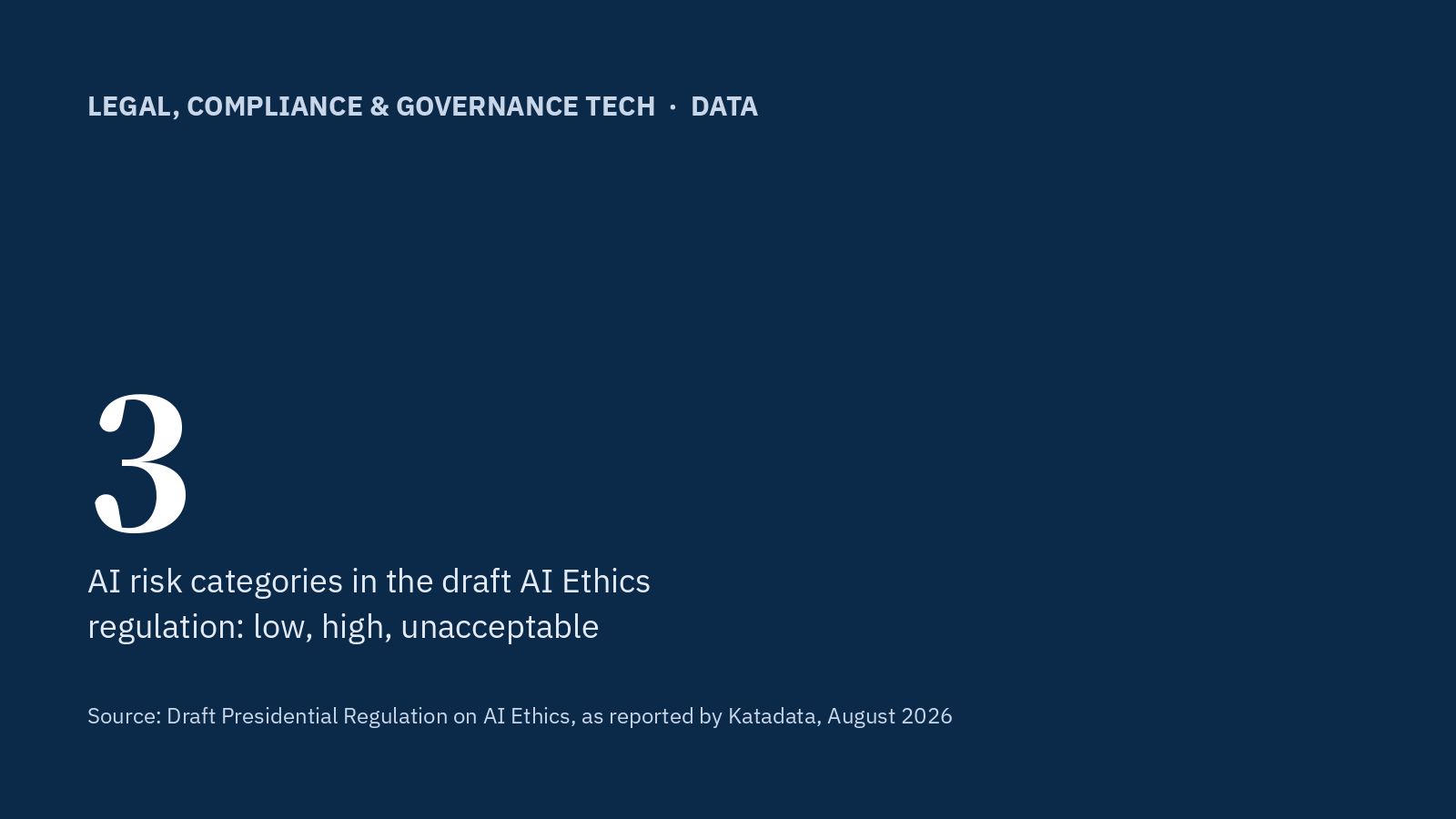
Graphic: VRI B2B Tech Asia Review. Data: Draft Presidential Regulation on AI Ethics, as reported by Katadata, August 2026.
NEWS IN BRIEF
Compiled from media reports. Direct quotes are marked and sources are listed.
• Komdigi and ministries across sectors completed review of the draft Presidential Regulation on Artificial Intelligence Ethics and the draft Presidential Regulation on the 2026–2029 National AI Roadmap on 5 May 2026. (JDIH Komdigi)
• On 3 September 2026, Edwin Hidayat Abdullah, Komdigi's Director General of Digital Ecosystem, said both regulations were awaiting the President's signature. As of 15 November 2026, we have found no report that either has been signed. (Selular.ID)
• Minister Meutya Hafid said Komdigi is preparing the umbrella rules, while technical rules will be drafted by each sector. The roadmap covers 10 priority sectors, including health, education, and economy and finance. (detikInet)
• The draft AI Ethics regulation divides AI risk into three categories: low, high and unacceptable. High-risk systems must undergo risk assessment from the design stage, and AI-generated content is planned to require labels. (Katadata)
• Komdigi kept a provision requiring every type of AI operational incident to be reported, regardless of risk level. (Bisnis.com)
EXPLAINER
Who is most affected
According to the reported draft, high-risk systems are AI that uses certain personal data or has a major impact on human rights, safety and essential public services. This category is likely to cover credit scoring, recruitment, health services and identity verification. Companies in financial services, health and telecommunications should pay attention first.
Incident reporting duties are easy to miss
Many companies have procedures for cybersecurity incidents but none for AI incidents, such as a chatbot giving wrong information or a model rejecting customers unreasonably. If every AI operational incident must be reported, companies need to define what counts as an incident and who is responsible for reporting it.
Sector rules will set the details
The Presidential Regulations are only an umbrella. Technical details and sanctions will come from sector regulators, such as OJK for financial services, and from Komdigi ministerial regulations on content labeling. Companies that wait for sector rules before acting will have little time to prepare.
WHAT IT MEANS FOR YOU
5 things companies should prepare
1. Inventory AI systems and classify each as low, high or unacceptable risk.
2. Risk assessment by design for systems that use personal data or affect important decisions about people.
3. Labels and transparency: prepare ways to tell users they are interacting with AI and to mark AI-generated content.
4. AI incident procedures: an incident definition, an escalation path and an owner for reporting.
5. Sector regulation monitoring: name one owner to track implementing rules from Komdigi and your sector regulator.
For solution providers
Compliance features such as audit logs, explanations of model decisions and automatic labeling will become requirements in enterprise procurement once the regulations take effect.
FREQUENTLY ASKED QUESTIONS
Are Indonesia's AI regulations in force?
As of 15 November 2026, we have found no report that either regulation has been signed. Komdigi said both are awaiting the President's signature.
Are there sanctions?
Planned sanctions for violations of AI content labeling will be set out in a separate ministerial regulation. The details have not been published.
SOURCES
1. JDIH Komdigi — Pembahasan RPerpres Etika KA dan Peta Jalan KA Nasional selesai, 2026-05-05
2. Selular.ID — Dua Perpres AI Tunggu Tanda Tangan Presiden Prabowo, 2026-09-03
3. detikInet — Tak Mau AI Lepas Kendali, Pemerintah Pastikan Perpres AI Terbit Tahun Ini, 2026-06-12
4. Katadata — Bocoran Aturan AI yang Segera Terbit: Label, MBG, Tiga Tingkat Risiko, 2026-08-07
5. Bisnis.com — Jawab Keraguan AS, Komdigi Pastikan Prinsip Etika AI Mengacu Standar Internasional, 2026-06-18
Quotations are used sparingly and credited to their source. Copyright in quoted material remains with each publisher. Analysis reflects the view of the VRI B2B Tech Asia Review editors.