
News › AI & Automation Hub › Cloud & IT Infrastructure › Analysis
ANALYSIS · CLOUD & IT INFRASTRUCTURE
Draft Regulation Splits Data Centers into 3 Classes: Sites of 3 MW and Above Steered to SEZs, IDPRO Asks for Review
A draft Presidential Regulation on submarine cable systems and data centers groups data centers by IT load and sets location and efficiency limits. Class A facilities (3 MW and above) built after the rule is issued must sit in a special economic zone or industrial estate, and the providers' association wants the threshold reviewed.
VRI B2B Tech Asia Review editors · 20 November 2026, 06:00 WIB · 4 min read
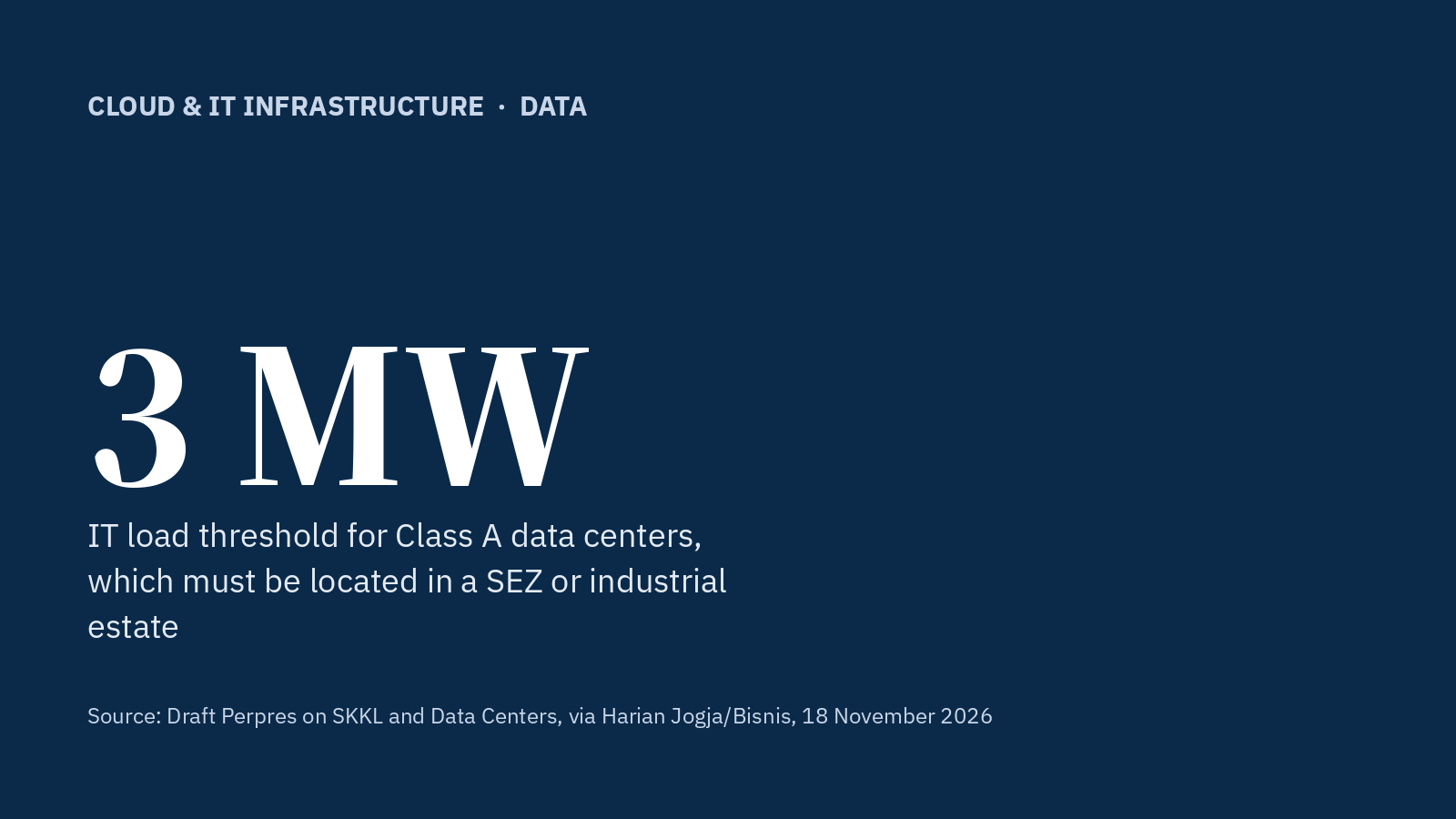
Graphic: VRI B2B Tech Asia Review. Data: Draft Perpres on SKKL and Data Centers, via Harian Jogja/Bisnis, 18 November 2026.
NEWS IN BRIEF
Compiled from media reports. Direct quotes are marked and sources are listed.
• The Directorate General of Digital Infrastructure (DJID) at Komdigi is preparing a draft Presidential Regulation (Perpres) on Submarine Cable Communication Systems (SKKL) and Data Centers that sorts data centers into three classes by IT load: Class A at 3 MW or more, Class B from 50 kW to under 3 MW, and Class C under 50 kW (Harian Jogja/Bisnis and Editor Indonesia, 18 November 2026).
• Class A facilities built after the Perpres is issued must be located in a Special Economic Zone (KEK) or industrial estate and may not sit in residential or commercial areas. Class B is barred from residential areas, while Class C may be located in residential areas.
• The draft sets maximum PUE and water intensity by class and location, for example PUE 1.3 and 2 liters per kWh for Class A in a KEK, and PUE 1.2 and 2.5 liters per kWh for Class C in residential areas. Carbon efficiency is measured with CUE.
• IDPRO chair Hendra Suryakusuma supports classification for capacity mapping but says the technical basis of the 3 MW threshold needs review, and asks the government to clarify whether capacity means design, installed or actual operating load.
• IDPRO also wants KEKs and industrial estates to be priority locations with incentives rather than the only permitted sites, plus certainty for investments already under way or planned.
BEHIND THE NEWS
The 3 MW threshold decides who must move to a zone
The core of the draft is not the class label but its location consequence. Once a new facility falls into Class A, its location options narrow to a KEK or industrial estate. Because 3 MW is a relatively low threshold for commercial multi-tenant data centers, most colocation and AI-ready projects now being planned are likely to fall into Class A. This is where IDPRO's objection matters most: without a firm definition of capacity, a facility could be Class B by actual load but Class A by design capacity. That difference decides whether a city site remains usable.
Efficiency limits do not run in the expected order
The draft's efficiency caps are strictest for small facilities in dense areas: Class C in residential areas is capped at PUE 1.2, tighter than Class A in a KEK at 1.3. The logic is understandable, since a data center in a neighborhood competes directly with residents for power and water. It is worth noting, however, that small server rooms usually struggle to reach such a low PUE because they lack the cooling scale of large facilities. If the caps stay, the impact could fall on corporate server rooms, branch offices and edge sites, not just large operators. IDPRO itself notes that PUE and WUE depend on climate, cooling method, utilization and load, so targets should be phased.
Who gains and who bears the cost
KEK and industrial estate operators that already have power and water supply in place stand to gain most, as Class A demand will be steered to them. Developers who bought land outside such zones, and companies planning their own mid-sized data centers, face uncertainty. The draft says the location rule applies to Class A facilities built after the Perpres is issued, but the sources do not explain what happens to facilities still under construction or in permitting.
What the draft does not yet answer
The reports we read do not give the draft's number, a timetable, a transition period, sanctions, or which body will audit PUE and water intensity. The text is also unclear: the location rule allows Class A in industrial estates, but the efficiency table lists values only for Class A in a KEK. These points are likely to dominate the next round of public consultation.
WHAT IT MEANS FOR YOU
For CIOs and Infrastructure Leads
1. Map every company-owned facility, including branch server rooms, by design, installed and actual IT load, then check which class could apply under each definition.
2. Measure current PUE and water use with a documented method, since the Class C residential cap (PUE 1.2) may be hard for small server rooms to meet.
3. If you plan a new facility above 3 MW, include KEK and industrial estate options in the feasibility study now, including latency and network costs back to headquarters.
For CFOs
Model relocation or colocation cost scenarios in case an in-house data center project falls into Class A, and hold off on land commitments outside zones until the final rule is issued.
For data center providers and estate operators
Submit technical data on capacity definitions and realistic efficiency targets during consultation on the draft; estate operators can prepare power, water and connectivity packages to absorb Class A demand.
FREQUENTLY ASKED QUESTIONS
What data center classes are in the draft Perpres?
Class A with IT load of 3 MW or more, Class B from 50 kW to under 3 MW, and Class C under 50 kW.
Can data centers be built in urban areas?
Under the draft, new Class A facilities may not be in residential or commercial areas and must be in a KEK or industrial estate. Class B may be in buildings outside residential areas, and Class C may be in residential areas.
When will the data center classification apply?
No date has been set. The rule is still a draft Perpres, and the sources give no issuance date or transition period.
SOURCES
1. Harian Jogja (sumber: Bisnis) — Pemerintah Siapkan Klasifikasi Data Center, Industri Soroti Batas 3 MW, 2026-11-18
2. Editor Indonesia — Pemerintah Atur Lokasi Data Center Berdasarkan Kapasitas Listrik, Ini Ketentuannya, 2026-11-18
Quotations are used sparingly and credited to their source. Copyright in quoted material remains with each publisher. Analysis reflects the view of the VRI B2B Tech Asia Review editors.