
News › Back Office & Operations Hub › HR Tech & Workforce Management › Analysis
ANALYSIS · HR TECH & WORKFORCE MANAGEMENT
Indonesia's Manpower Ministry Sets 3 Priorities for AI Disruption as IBM-Dicoding Target 40,000 Trainees
Manpower Minister Yassierli set three priorities to deal with AI's impact on the workforce, while IBM and Dicoding launched the Pijak 2027 AI training programme with a target of 40,000 participants. Last year's programme data show that the main problem is not access but how many participants reach in-depth training.
VRI B2B Tech Asia Review editors · 16 November 2026, 10:30 WIB · 3 min read
Graphic: VRI B2B Tech Asia Review. Data: Tribunnews, 13 November 2026.
NEWS IN BRIEF
Compiled from media reports. Direct quotes are marked and sources are listed.
• Manpower Minister Yassierli, speaking in Jakarta on Friday 13 November 2026, set out three priority programmes to deal with AI disruption: improving workforce competence, raising productivity and protecting workers. He asked businesses to help design vocational training curricula. (Disway)
• The productivity programme is run with the Asian Productivity Organization (APO), including support for companies on business process improvement. The ministry is also widening training access for people with disabilities. (Disway)
• Dicoding Indonesia and IBM, through IBM SkillsBuild, launched the Pijak 2027 AI training scholarship in Jakarta on 12 November 2026, targeting 40,000 participants and open to vocational high school students, vocational college students and people aged 18–34. (Tribunnews)
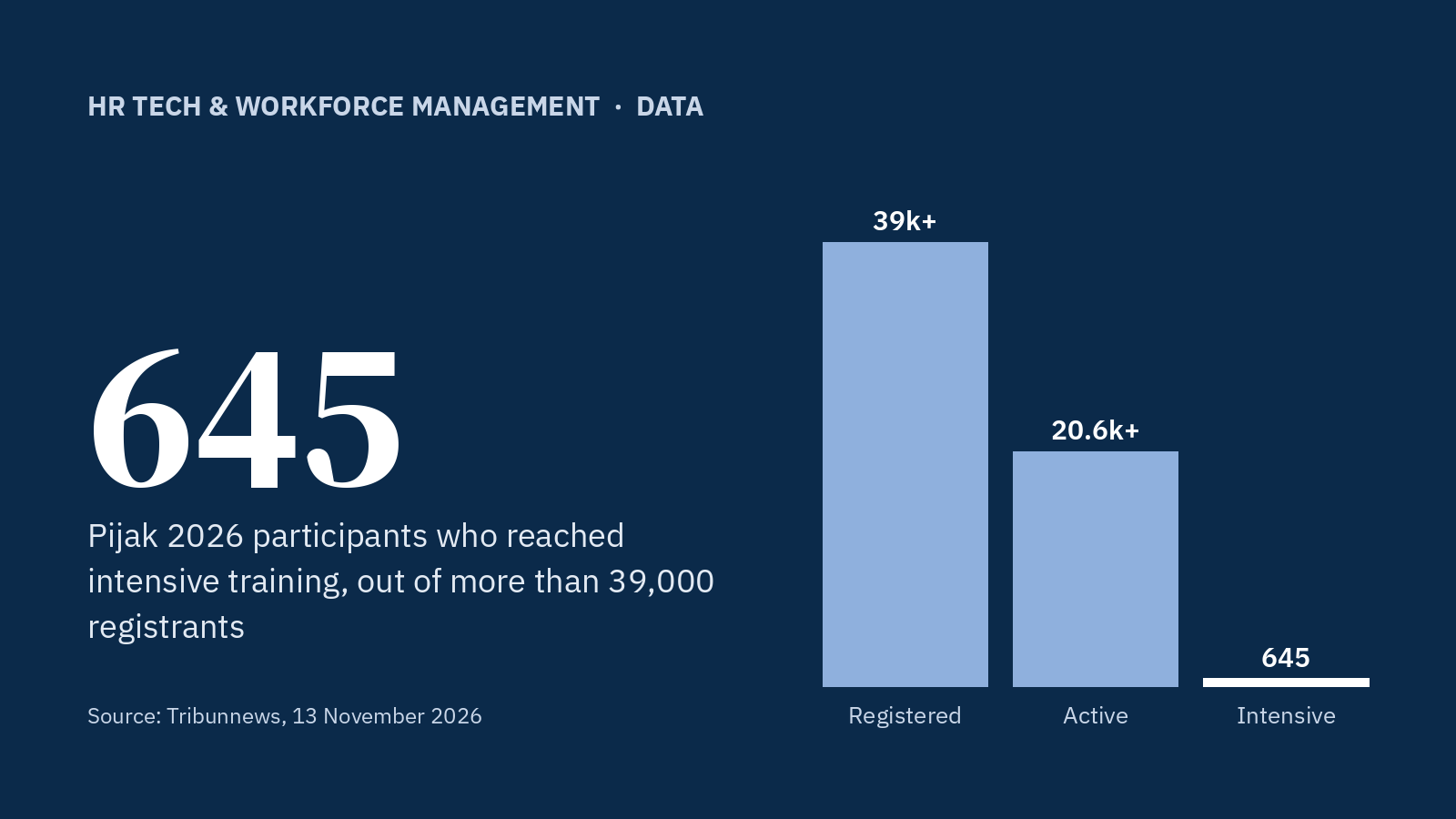
• The best 800 participants will take 798 hours of intensive training. In the 2026 edition, more than 39,000 people registered, more than 20,600 actively studied, and 645 were selected for intensive training. (Tribunnews)
• IBM Indonesia CTO Wisu Suntoyo stressed the need for skills to use AI effectively and responsibly. Dicoding CEO Narenda Wicaksono said AI skills are now needed by professionals outside technology career paths as well. (Tribunnews)
BEHIND THE NEWS
The training funnel narrows sharply
The Pijak 2026 figures show a pattern common in mass digital training programmes: of more than 39,000 registrants, about half studied actively, and only 645 entered intensive training. The 2027 target follows a similar structure, with 800 intensive places out of 40,000 participants. The programme is therefore better read as large-scale AI literacy plus a narrow talent track, not a producer of tens of thousands of job-ready AI workers. Companies hoping to hire ready-made graduates from such programmes should adjust their expectations.
The government is asking companies to help design curricula
The most relevant message from the ministry for HR directors is the request that businesses take part in curriculum design and on-the-job practice. The AI skills gap cannot be left entirely to the government or training providers. Companies that engage actively can shape a talent supply that fits their needs; passive ones will likely have to compete for the same talent at higher cost.
What is not explained
Neither source includes outcome data: how many alumni went on to work, in which roles, or how many companies hired them. The ministry has also not detailed the budget, quantitative targets or schedule for its three priorities. Without measures of success such as job placement rates, it is hard to judge whether these programmes actually reduce disruption risk or simply widen access to courses.
A shift from hiring to reskilling
Dicoding's point that non-technology professionals also need AI skills matches a shift companies should watch: the biggest need is likely not more AI engineers but reskilling finance, marketing, customer service and operations staff to use AI safely in daily work. For HR tech providers, this creates demand for internal learning platforms linked to performance data.
WHAT IT MEANS FOR YOU
For HR Directors and Chief People Officers
1. Map the roles most affected by AI and build reskilling paths per role, not one AI course for everyone.
2. Measure training outcomes by changes in productivity or work quality, not only by the number of course completions.
3. Explore curriculum partnerships with vocational schools, polytechnics or government training programmes, as the ministry has invited.
4. Set internal rules for AI use so that training is followed by safe practice.
For CIOs
Provide company-approved AI environments so that newly trained employees do not turn to unmanaged tools.
For HR tech and training providers
Offer learning-outcome measurement linked to performance data, because that is the biggest gap in mass training programmes.
FREQUENTLY ASKED QUESTIONS
What are the Manpower Ministry's three priorities for AI disruption?
Improving workforce competence, raising productivity and protecting workers, as stated by Minister Yassierli on 13 November 2026.
Who can join the Pijak 2027 AI scholarship?
Vocational high school students, vocational college students and people aged 18–34, including new graduates, job seekers, early-career workers, professionals and career switchers.
SOURCES
1. Disway — Kemnaker Siapkan 3 Program Prioritas Hadapi Disrupsi AI, Fokus Tingkatkan Kompetensi dan Lindungi Pekerja, 2026-11-14
2. Tribunnews — Beasiswa AI 2027 Sasar 40.000 Peserta, Kemenaker: Siapkan Talenta Hadapi Kebutuhan Industri, 2026-11-13
Quotations are used sparingly and credited to their source. Copyright in quoted material remains with each publisher. Analysis reflects the view of the VRI B2B Tech Asia Review editors.