
News › Back Office & Operations Hub › Logistics & Supply Chain Tech › Analysis
ANALYSIS · LOGISTICS & SUPPLY CHAIN TECH
KAI Logistik Moves 164,142 Tons of Halal Cargo by Rail, Rising Each Quarter: An Early Test for the Logistics Decree
KAI Logistik's halal container freight by rail reached 164,142 tons through October 2026, with manufacturers and FMCG companies as the main users. As the government aims to cut logistics costs under Presidential Regulation 41/2026, the figure shows how far the shift from trucks to rail has gone, and what it cannot tell us yet.
VRI B2B Tech Asia Review editors · 18 November 2026, 06:00 WIB · 4 min read
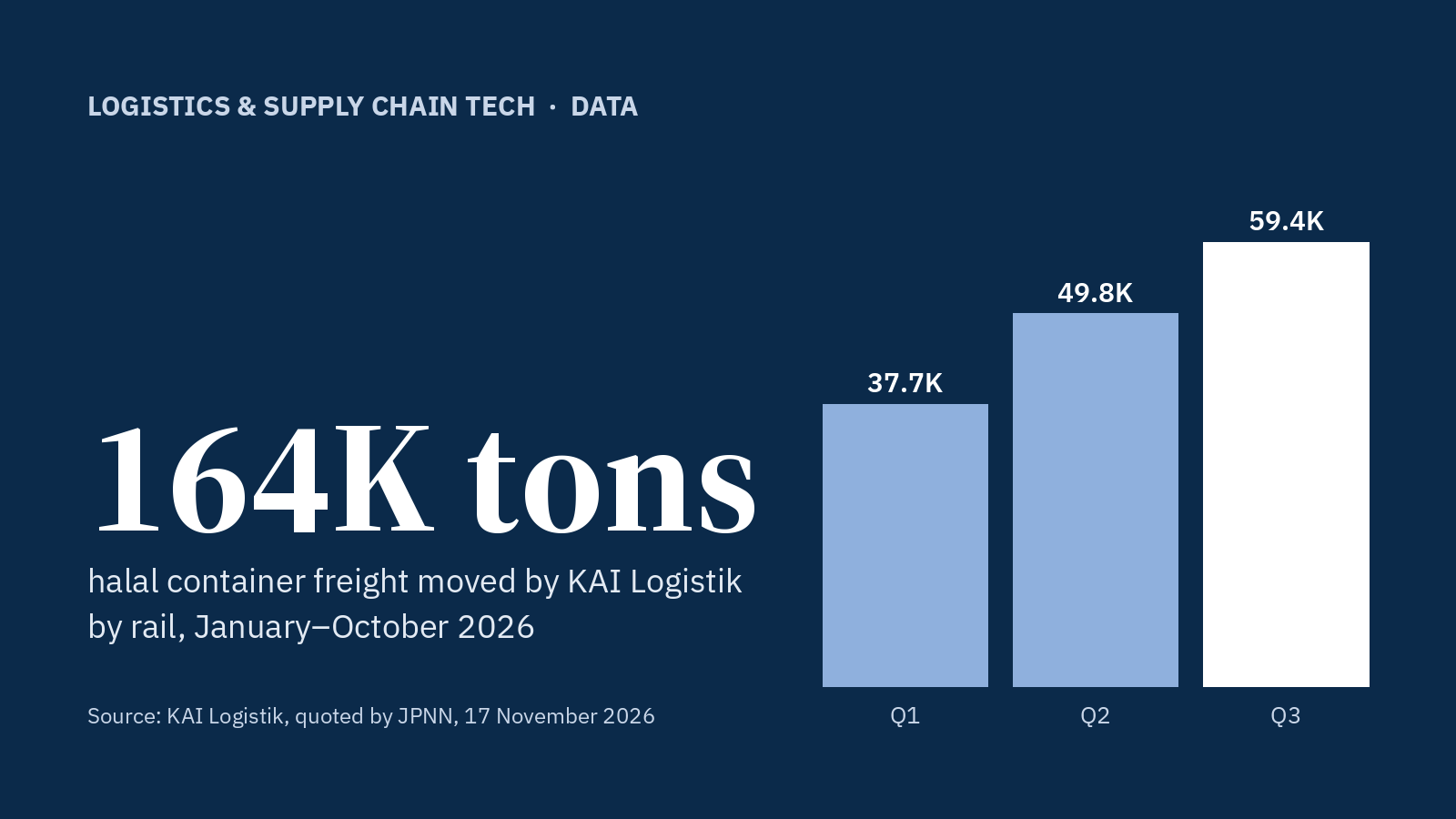
Graphic: VRI B2B Tech Asia Review. Data: KAI Logistik, quoted by JPNN, 17 November 2026.
NEWS IN BRIEF
Compiled from media reports. Direct quotes are marked and sources are listed.
• KAI Logistik reports that halal container freight by rail reached 164,142 tons from January to October 2026. The figure was given by Business Development Director Aniek Dwi Deviyanti. (JPNN, 17 November 2026)
• Quarterly volumes: 37,710 tons (Q1), 49,842 tons (Q2) and 59,418 tons (Q3, the highest). October, the first month of Q4, recorded 954 TEUs, or 17,172 tons. (JPNN)
• Customers are mainly manufacturing and FMCG companies, and KAI Logistik expects the positive trend to continue through year-end. (JPNN)
• Presidential Regulation 41/2026 on Strengthening National Logistics, enacted on 16 July 2026, targets cutting logistics costs from about 14.29% of GDP toward 12.5% and eventually 8% of GDP, prioritizing integration of road, rail and sea transport. (CNN Indonesia, Fortune Indonesia)
BEHIND THE NEWS
Clear growth, but October deserves a closer look
From Q1 to Q3, volume rose from 37,710 tons to 59,418 tons, about 58%. Q3 was roughly 19% above Q2. October, however, came in at 17,172 tons, below Q3's monthly average of about 19,800 tons (59,418 divided by three). One month is not enough to call a slowdown; seasonality, container scheduling or fleet capacity could explain it. The source gives no explanation, so readers should wait for November and December data before naming a trend.
Why halal cargo is an interesting yardstick
Aniek stressed that halal logistics is not only about certification but about preserving product integrity through storage, handling and delivery. For corporate buyers, that means a need for auditable tracking and records along the shipping chain. JPNN does not say which digital systems KAI Logistik uses, so we cannot judge how automated that tracking already is. This is a gap worth raising with logistics providers.
The link to Regulation 41/2026: aligned, but unproven
Regulation 41/2026 makes modal integration and digitalization core strategies, including expanding the National Logistics Ecosystem (NLE) platform into end-to-end digitalization and building dry ports, among them at the Batang Integrated Industrial Estate. The government claims NLE has cut logistics costs by up to 17% and service times by 73%; these are government claims and were not independently verified in the reports we read. KAI Logistik's rising volume is consistent with the policy direction, but no source says the increase was caused by the regulation, so causality cannot be established. Note also that sources differ on the basis of the 14.29% of GDP figure: CNN Indonesia ties it to 2022 data, while Fortune Indonesia presents it as the current level.
Who gains and what comes next
Manufacturing and FMCG shippers with large volumes and predictable schedules are most likely to benefit from rail. Carriers that depend entirely on trucks face pressure to find a role in multimodal chains; the government itself is offering financing through the Labor-Intensive Industry Credit (KIPK) to renew aging truck fleets. What will probably matter most is data readiness: containers moving between modes only deliver savings if their status is visible to cargo owners in real time.
WHAT IT MEANS FOR YOU
For heads of logistics and supply chain
1. Recalculate high-cost routes that still rely entirely on trucks and test the feasibility of rail or multimodal options on them.
2. Ask providers to explain how containers are tracked and how handling records are kept, especially for products that need halal assurance.
3. Do not draw conclusions from one month of data; compare November–December volumes before changing contracts.
For CIOs and operations directors
1. Make sure transport and warehouse management systems can receive status data from several modes and providers.
2. Follow the implementing rules of Regulation 41/2026 and NLE developments so customs and licensing data integration is not built twice.
For logistics technology vendors
Opportunities lie in cross-modal visibility, container tracking and auditable halal compliance records. Offer proof of results on real routes, not generic claims.
FREQUENTLY ASKED QUESTIONS
How much halal container freight did KAI Logistik move by rail in 2026?
Through October 2026 the volume was 164,142 tons: 37,710 tons in Q1, 49,842 tons in Q2, 59,418 tons in Q3 and 17,172 tons in October, according to KAI Logistik as quoted by JPNN.
What does Regulation 41/2026 target for logistics costs?
The government aims to cut logistics costs from about 14.29% of GDP toward 12.5% and eventually 8% of GDP, with no firm deadline in the reports we read. The strategy covers infrastructure, integration and digitalization, and the competitiveness of workers and logistics providers.
Is the volume increase a result of Regulation 41/2026?
No source says so. The regulation was enacted in July 2026 and the volume increase was already visible from Q1, so the relationship cannot be established.
SOURCES
1. JPNN — Volume Angkutan KAI Logistik Capai 164 Ribu Ton, 2026-11-17
2. CNN Indonesia — Pemerintah Optimistis Perpres 41/2026 Mampu Pangkas Biaya Logistik RI, 2026-10-17
3. Fortune Indonesia — Biaya Logistik Nasional Ditargetkan Turun hingga 8 Persen, 2026-10-16
Quotations are used sparingly and credited to their source. Copyright in quoted material remains with each publisher. Analysis reflects the view of the VRI B2B Tech Asia Review editors.