
News › Back Office & Operations Hub › FinTech & Financial Operations › News
NEWS · FINTECH & FINANCIAL OPERATIONS
BI, BNM, BOT and BSP Sign Local Currency Transaction MoU: Philippines Joins, Rupiah-Peso Without the Dollar
Bank Indonesia, Bank Negara Malaysia, the Bank of Thailand and Bangko Sentral ng Pilipinas signed a new memorandum of understanding on local currency transactions (LCT) on 13 November 2026. For CFOs of companies trading with the Philippines, Malaysia and Thailand, it opens the option of settling without double conversion through the US dollar.
VRI B2B Tech Asia Review editors · 16 November 2026, 09:00 WIB · 3 min read
Graphic: VRI B2B Tech Asia Review. Data: Bank Indonesia, 13 November 2026.
NEWS IN BRIEF
Compiled from media reports. Direct quotes are marked and sources are listed.
• On 13 November 2026, BI Governor Destry Damayanti, BNM Governor Abdul Rasheed Ghaffour, BOT Governor Vitai Ratanakorn and BSP Governor Eli M. Remolona Jr. signed an MoU on cooperation under the local currency transaction framework. (Bank Indonesia)
• The MoU sets a framework for the four central banks to promote local currency use in bilateral cross-border transactions, including trade and investment. It replaces the agreement made by BI, BNM and BOT in August 2023. (Bank Indonesia, Bernama)
• The stated aims: more efficient cross-border settlement, lower costs from multiple currency conversions, and more flexibility for businesses in managing exchange rate risk. (Bank Indonesia, Bernama)
• On the same day, BI and BSP also signed a broader bilateral MoU covering payment systems, digital financial innovation, cybersecurity, Islamic finance and anti-money laundering. Remolona called the cooperation crucial at a time of rising uncertainty. (CNBC Indonesia)
• The official release contains no LCT volume data or implementation schedule. (Bank Indonesia)
BEHIND THE NEWS
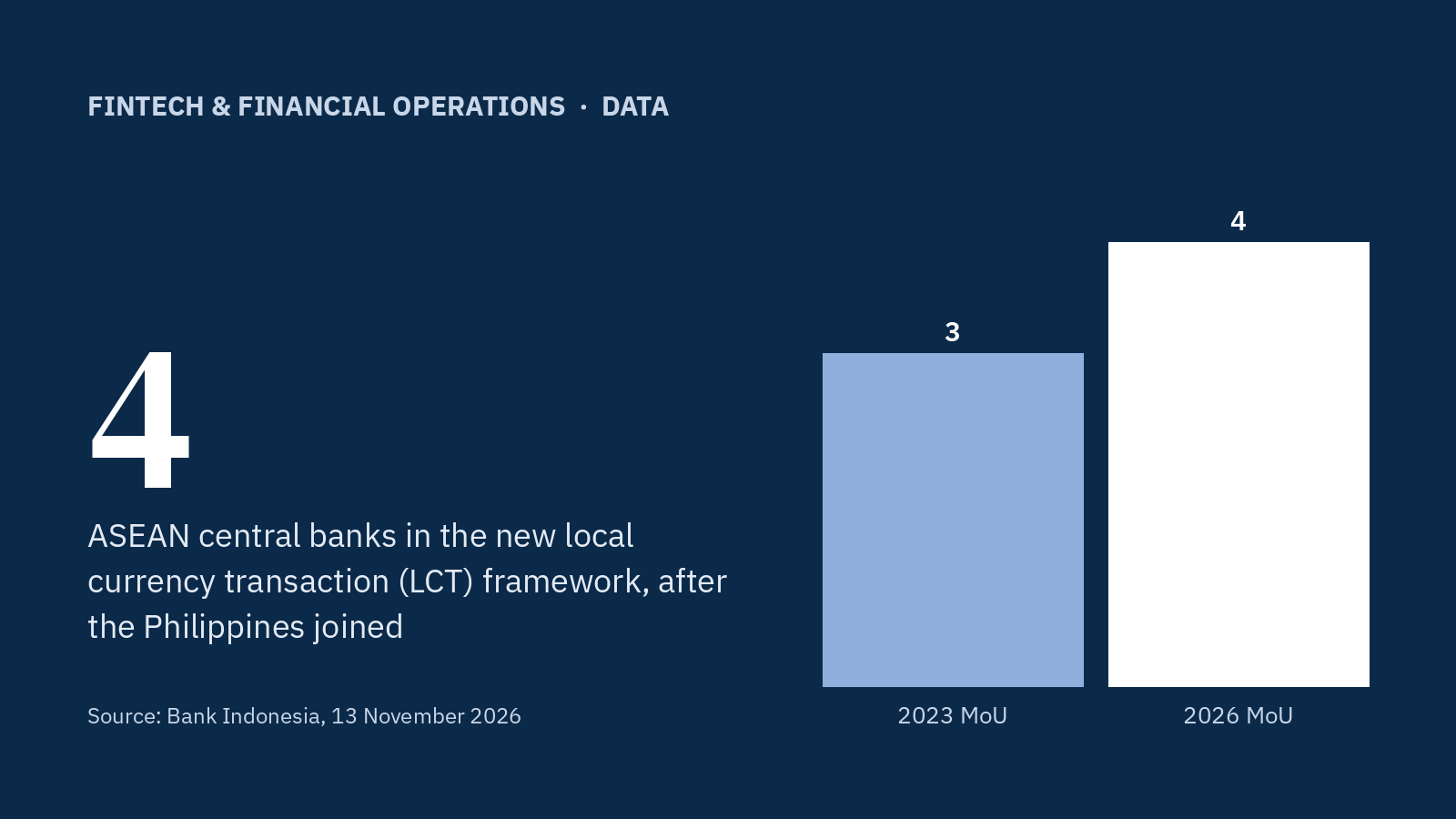
From three to four: the Philippine corridor is the newest
The LCT framework between Indonesia, Malaysia and Thailand has been running since the 2023 agreement. What is new in this MoU is the Philippines joining and the cooperation being brought into one four-party framework. For Indonesian companies, the rupiah-peso corridor is the one to watch, because transactions with Philippine partners were not previously covered by this LCT framework. The bilateral BI-BSP cooperation signed at the same time, covering payment systems and cybersecurity, suggests that a payment link between the two countries is likely to be a next step.
Real benefits depend on banks and liquidity
A central bank MoU is only a framework. Companies benefit only when commercial banks offer competitive direct rupiah-peso quotes, enough liquidity and hedging products. The official release mentions no volumes, implementing banks or schedule, so it is worth watching how quickly the framework turns into banking products for the Philippine corridor. Adoption is likely to be gradual.
Part of a bigger agenda
The signing came a day before ASEAN signed the DEFA digital economy agreement, which also targets cross-border payment systems. Both point to the same goal: cheaper intra-ASEAN transactions that depend less on the US dollar. For corporate finance functions, this means regional multi-currency cash management will become a need, no longer only a concern for large corporations.
Who benefits most
Mid-sized exporters and importers that trade regularly with Malaysia, Thailand and the Philippines benefit most, because multiple conversion costs weigh more on their margins. Cross-border payment providers and treasury software also gain room, while companies whose contracts are all denominated in US dollars should review whether that structure is still the most efficient.
WHAT IT MEANS FOR YOU
For CFOs and treasurers
1. Map transactions with partners in Malaysia, Thailand and the Philippines, including the currencies used and current conversion costs.
2. Ask partner banks whether they offer direct settlement in ringgit, baht or peso, with rates and hedging products.
3. Consider local-currency clauses in new contracts if costs are lower.
4. Make sure ERP and accounting systems can record and reconcile regional multi-currency transactions.
For fintechs and payment providers
Prepare payment and cash management products for the rupiah-peso corridor, and follow up on the BI-BSP payment system cooperation.
FREQUENTLY ASKED QUESTIONS
What is Local Currency Transaction (LCT)?
LCT is a framework that encourages cross-border transactions to be settled directly in the two countries' currencies, such as rupiah and peso, without going through the US dollar.
How does the four-central-bank MoU differ from the BI-BSP MoU?
The four-party MoU covers only the LCT framework between Indonesia, Malaysia, Thailand and the Philippines. The BI-BSP MoU is bilateral and broader, covering payment systems, cybersecurity and Islamic finance, among others.
SOURCES
1. Bank Indonesia — Bank Indonesia, Bank Negara Malaysia, Bank of Thailand, dan Bangko Sentral ng Pilipinas Memperkuat Kerja Sama dalam Kerangka Mata Uang Lokal, 2026-11-13
2. Bernama — Four ASEAN Central Banks Sign MoU On Local Currency Transaction Framework, 2026-11-13
3. CNBC Indonesia — Lindungi Rupiah-Peso, RI & Filipina Perkuat Transaksi Tanpa Dolar AS, 2026-11-13
Quotations are used sparingly and credited to their source. Copyright in quoted material remains with each publisher. Analysis reflects the view of the VRI B2B Tech Asia Review editors.