
News › Growth & Revenue Hub › E-Commerce & Retail Tech › Analysis
ANALYSIS · E-COMMERCE & RETAIL TECH
Indonesia's E-Commerce Seen Reaching US$85 Billion in 2026, With 37% of Shopping Journeys Starting with AI
The e-Conomy SEA 2026 report by Google, Temasek and Bain and Company estimates Indonesia's e-commerce transaction value rising 16% to US$85 billion. It also shows AI entering the start of the shopping process, while AI-agent payments remain at an early stage.
VRI B2B Tech Asia Review editors · 19 November 2026, 07:30 WIB · 3 min read
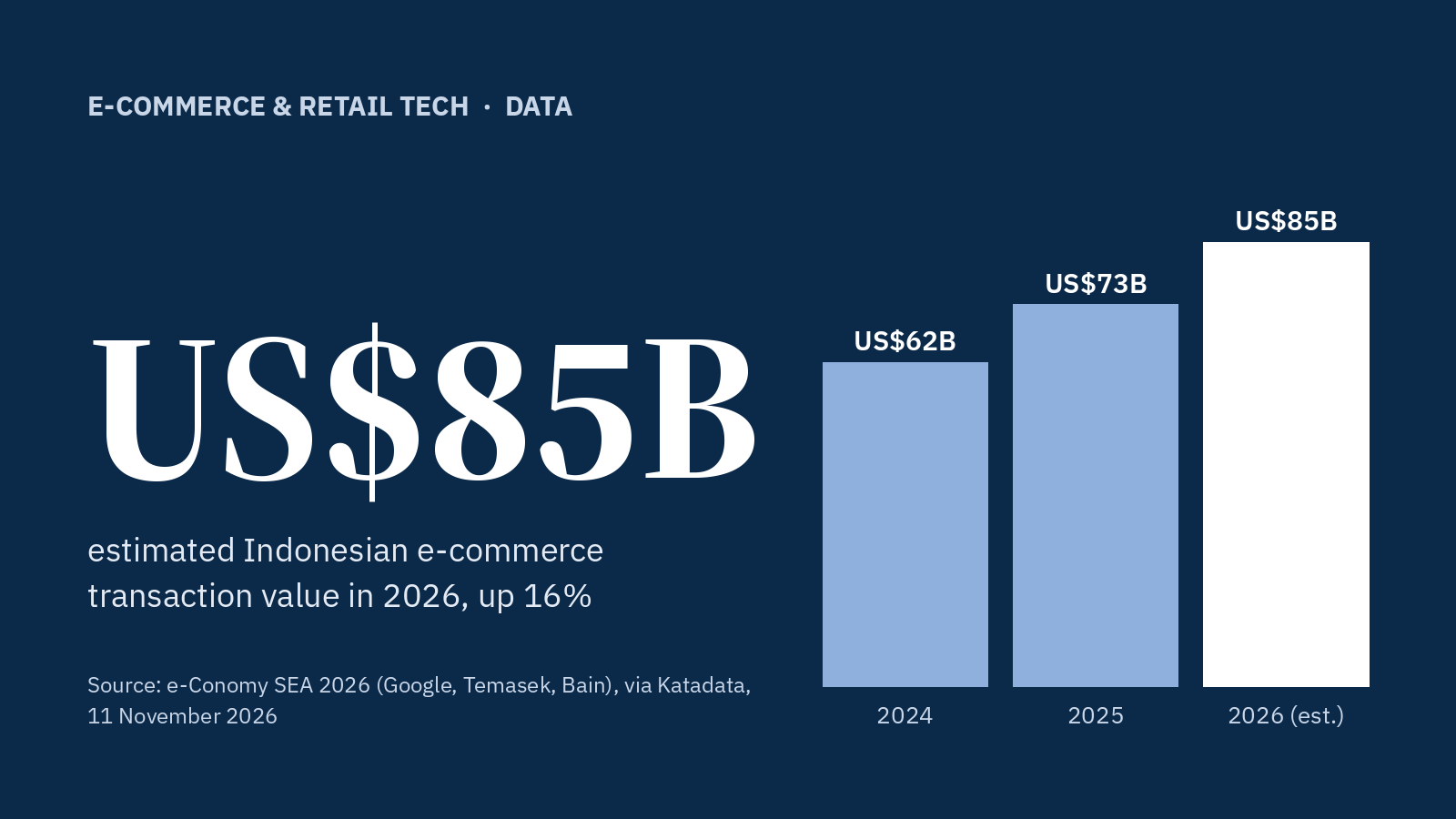
Graphic: VRI B2B Tech Asia Review. Data: e-Conomy SEA 2026 (Google, Temasek, Bain), via Katadata, 11 November 2026.
NEWS IN BRIEF
Compiled from media reports. Direct quotes are marked and sources are listed.
• Katadata (11 November 2026), citing the e-Conomy SEA 2026 report, reports estimated 2026 Indonesian e-commerce transaction value of US$85 billion (Rp1,541 trillion at Rp18,130), up 16% from US$73 billion; the 2024 value was US$62 billion.
• The report projects US$175 billion in 2030 and US$362 billion in 2035.
• 37% of consumer shopping journeys in Indonesia begin with AI assistance, and 84% of surveyed AI users would let an AI agent find the best price and complete a purchase, versus a 75% average across six Southeast Asian countries.
• More than 90% of consumers still do extra research or read reviews after an AI recommendation, and agentic checkout is described as still in development.
• Lazada and Shopee report AI results: Lazada's assistant Lazzie reached about 3 million daily active users during the 6.6 campaign, and Shopee's chatbot handles about 80% of consumer questions with cost per contact down 30% year on year.
BEHIND THE NEWS
16% growth and the role of AI
The US$85 billion estimate puts Indonesian e-commerce on a double-digit growth path, but the report we read does not explain how much of the increase comes from AI. The AI data and the transaction-value data are two separate findings; causality is not shown. The only figure linking the two is Lazada's claim that AI-guided orders have an average order value about 75% higher, which is a company claim, not an independent survey finding.
High willingness, habits not yet changed
There is a gap between willingness and behaviour. 84% of AI users would hand purchases to an AI agent, yet Indonesian users average just 1.76 AI sessions per week, the lowest of the six countries, and more than 90% still check reviews after an AI recommendation. So trust in AI as an assistant (93%) does not automatically mean consumers will hand over the final decision. For businesses, AI recommendations appear to be an entry point, while reviews and store reputation remain the decider.
Winners and those under pressure
Sellers with clean data (product titles, attributes, photos, reviews) are likely to be easier for AI assistants to find; Lazada says over 95% of its sellers use its AI Smart Listing feature, so that basic feature is becoming standard, not a differentiator. Small sellers reliant on twin-date promotions face other competition: JawaPos (10 November 2026) notes Harbolnas 2025 produced Rp36.4 trillion in transactions according to the Ministry of Trade, and 54% of consumers bought through creator affiliate links. That figure is not a direct comparison with the 2026 annual estimate because period and definition differ.
What the news does not say
The report does not explain the methodology behind per-platform transaction estimates, and the Lazada and Shopee performance figures come from the companies themselves. The 2030 and 2035 figures are projections; realisation will likely depend heavily on purchasing power and platform regulation.
WHAT IT MEANS FOR YOU
For CMOs and Heads of E-Commerce
1. Audit your product catalogue: complete, consistent titles, attributes and descriptions help products be found by AI shopping assistants.
2. Measure traffic sources and conversion per channel, including journeys that start in AI apps, not only search and social media.
3. Manage reviews and store reputation actively, since most buyers still check reviews after an AI recommendation.
For CIOs and operations leaders
1. Prepare product, stock and price data that can be reached through APIs so you are ready if agent-led checkout becomes available.
2. Review AI-based customer service using cost-per-contact and satisfaction measures, as Shopee reports.
For e-commerce and martech vendors
Focus offers on clean product data and cross-marketplace integration; do not promise autonomous checkout before the technology and consumer trust are ready.
FREQUENTLY ASKED QUESTIONS
What is Indonesia's e-commerce value in 2026 according to e-Conomy SEA?
An estimated US$85 billion, or Rp1,541 trillion, up 16% from US$73 billion, according to the report as cited by Katadata.
What share of Indonesian consumers start shopping with AI?
The report records that 37% of consumer shopping journeys in Indonesia begin with AI assistance.
Can AI agents already pay for purchases?
The report says agentic checkout or AI-agent payment is still in development.
SOURCES
1. Katadata — Transaksi Shopee hingga Lazada Rp1.541 Triliun, Warga RI Belanja Online Pakai AI, 2026-11-11
2. JawaPos — Promo 11.11 2026 Dorong Pertumbuhan Perdagangan Digital, 2026-11-10
Quotations are used sparingly and credited to their source. Copyright in quoted material remains with each publisher. Analysis reflects the view of the VRI B2B Tech Asia Review editors.