
News › Back Office & Operations Hub › Legal, Compliance & Governance Tech › Analysis
ANALYSIS · LEGAL, COMPLIANCE & GOVERNANCE TECH
US Requires Licences for AI Chip Exports to Indonesia and 4 Other Countries: Data Centers Must Vet Tenants Within 90 Days
An interim rule released by the US Commerce Department on 16 November 2026 requires licences for shipments of advanced AI chips to Indonesia, Malaysia, Singapore, Thailand and Brazil. Data centers anywhere that provide large computing capacity to China-headquartered companies also need a licence, turning customer verification into a compliance task for operators and tenants in Indonesia.
VRI B2B Tech Asia Review editors · 20 November 2026, 07:30 WIB · 4 min read
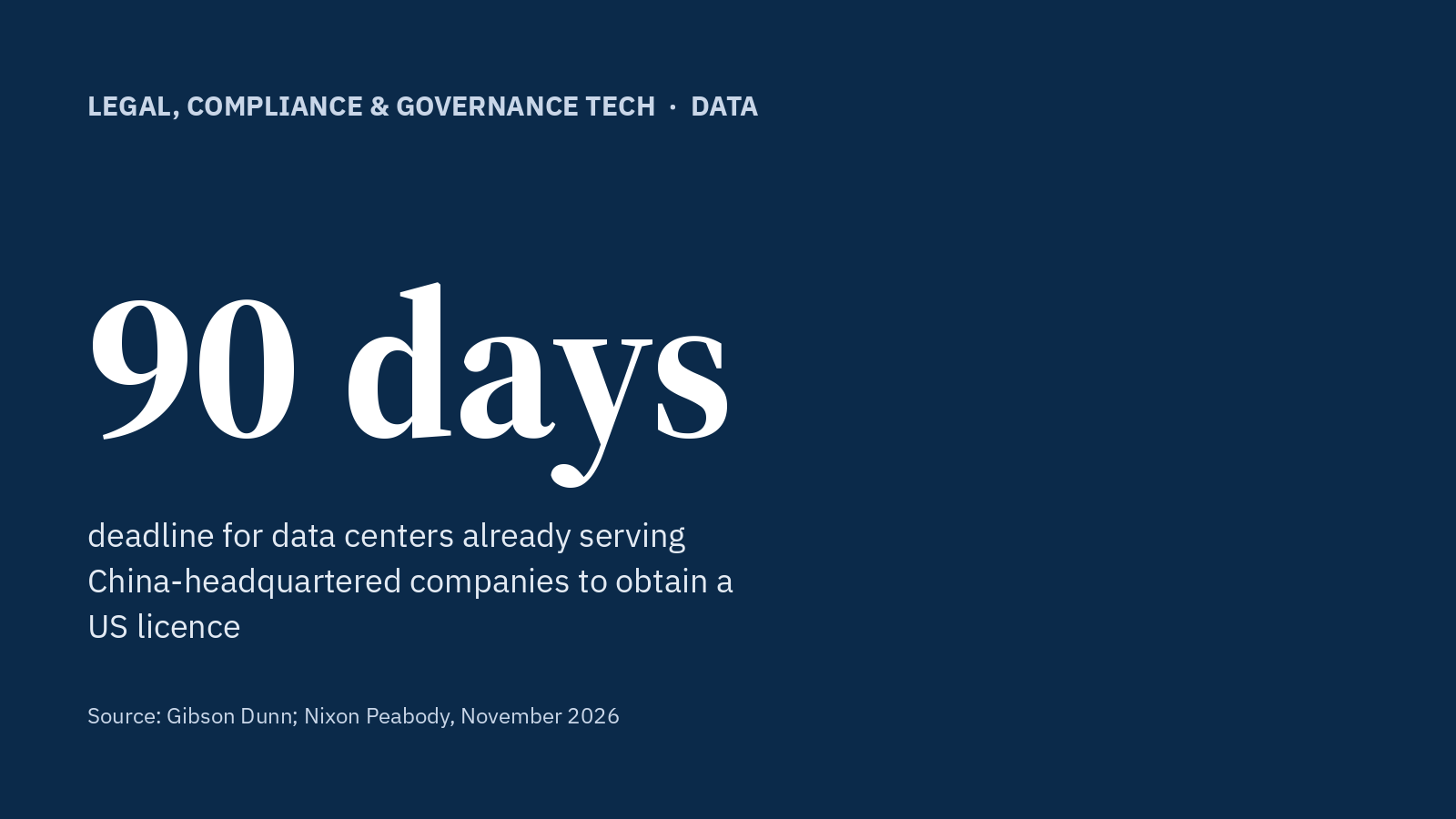
Graphic: VRI B2B Tech Asia Review. Data: Gibson Dunn; Nixon Peabody, November 2026.
NEWS IN BRIEF
Compiled from media reports. Direct quotes are marked and sources are listed.
• The US Commerce Department's Bureau of Industry and Security (BIS) released an interim final rule titled Addressing Remote Access to Advanced Semiconductors on 16 November 2026. According to Gibson Dunn, it takes effect on publication in the Federal Register, scheduled for 19 November 2026; public comments are due 60 days after publication.
• Exports, reexports and in-country transfers of advanced computing chips and systems (ECCN 3A090 and 4A090) to Indonesia, Malaysia, Singapore, Thailand and Brazil now require a licence. An exclusion applies to recipients headquartered in, or with an ultimate parent in, the US, subject to monthly reporting (Gibson Dunn; Nixon Peabody).
• Data centers anywhere that provide more than 12 million aggregate TPP to companies headquartered in China, Macau or Country Group D:5 must obtain a licence. Gibson Dunn says this is roughly 200 of one maker's most advanced GPUs. Existing arrangements must obtain a licence within 90 days of the effective date.
• Exporters are expected to collect know-your-customer information from data centers, including whether any customer is owned or controlled by persons in China; a refusal to provide it is treated as a red flag. The rule also rescinds the AI Diffusion Rule.
• Maybank Investment Bank, cited by TNGlobal (18 November 2026), called the rule "stricter than expected" and expects Indonesia to tighten enforcement, tenant verification and remote-access monitoring. For Indosat, Maybank expects under 10% of revenue to be affected; its Zankore project targets 1 GW by 2029, with a first 200 MW phase in the first half of 2027.
BEHIND THE NEWS
Indonesia joins the list of licensed destinations
The rule adds Indonesia to the list of destinations that require a licence. Now every shipment of covered chips to Indonesia needs a US licence unless the buyer has a US parent. The change reaches beyond data center operators: banks, telcos and companies building their own GPU clusters will also face licensing, waiting times and supplier questions about who the end user is. Gibson Dunn notes that BIS did not cite specific transactions as the reason for including Indonesia, and licence applications are reviewed case by case, taking enforcement in the destination country into account.
Compliance moves upstream: data centers must know their tenants
The most consequential part is the control on remote access. The 12 million TPP threshold measures capacity provided to China-headquartered companies, not where the chips physically sit. An operator in Batam or Jakarta renting out compute therefore needs to know its customers' ownership structure, including customers that train models for third parties. For operators this likely means new clauses in lease contracts, customer obligations to disclose ownership data, and usage monitoring systems. As Maybank expects, these compliance costs could dampen some China-linked investment.
Who is most affected
Maybank sees a larger impact on pure-play AI infrastructure and data center players than on telecom operators, while US hyperscaler demand is expected to be largely unaffected because US-parented customers are excluded. US-parented buyers can still obtain chips without per-shipment licences, while local buyers must go through licensing. It is worth watching whether this difference in treatment pushes Indonesian companies to rent more AI capacity from US-parented cloud providers instead of building their own clusters.
What remains unclear
The sources we read do not say how long BIS will take to process licences for Indonesia, and Gibson Dunn notes the text asks existing arrangements to obtain, not merely apply for, a licence within 90 days, which BIS may clarify or extend. The sources also contain no official response from the Indonesian government. The enforcement steps Maybank expects remain an analyst projection.
WHAT IT MEANS FOR YOU
For CIOs, CTOs and Infrastructure Leads
1. List GPU server purchases planned for the next 12 months and ask suppliers whether the equipment falls under ECCN 3A090 or 4A090 and how long licensing is expected to take.
2. Build US export licence waiting times into AI project schedules, and prepare an alternative using rented capacity from excluded cloud providers.
3. Prepare documents on your company's ownership structure, as suppliers and data center operators are likely to request them.
For compliance and legal heads
1. Set know-your-customer procedures for compute services, including checks on customers' parent companies and on customers' own customers.
2. Review capacity lease contracts and supplier agreements: add ownership representations, audit rights and termination rights for export-control breaches.
For data center operators and cloud providers
Calculate aggregate capacity provided to China-headquartered customers, including linked facilities, and if it approaches the 12 million TPP threshold, start the licensing process before the 90-day deadline.
FREQUENTLY ASKED QUESTIONS
Can Indonesian companies still buy AI chips from the US?
Yes, but shipments of covered chips to Indonesia now require a US licence reviewed case by case, unless the recipient is headquartered in or has an ultimate parent in the US and the exporter files monthly reports.
What is the 12 million TPP threshold?
The aggregate computing capacity a data center provides to companies headquartered in China, Macau or Country Group D:5. Above it, the data center needs a licence; Gibson Dunn puts it at roughly 200 of the most advanced GPUs.
When does the US AI chip rule take effect?
It was released on 16 November 2026 and takes effect on Federal Register publication, scheduled for 19 November 2026. Existing arrangements have 90 days to obtain a licence.
SOURCES
1. TNGlobal — US AI chip curbs could slow Indonesia's data center ambitions, says Maybank, 2026-11-18
2. Gibson Dunn — BIS Expands Advanced Computing Controls to Address Data Center Remote Access and Third Country Diversion, 2026-11-18
3. Nixon Peabody — BIS targets remote access to advanced chips through overseas data centers, 2026-11-17
Quotations are used sparingly and credited to their source. Copyright in quoted material remains with each publisher. Analysis reflects the view of the VRI B2B Tech Asia Review editors.