
News › Growth & Revenue Hub › E-Commerce & Retail Tech › Analysis
ANALYSIS · E-COMMERCE & RETAIL TECH
ASEAN Signs DEFA in Manila: Binding Cross-Border Rules on Data, Payments and AI for 11 Countries
ASEAN member states signed the Digital Economy Framework Agreement (DEFA) in Manila on 14 November 2026, the region's first standalone, legally binding digital economy agreement. For Indonesian companies that sell or pay across borders, DEFA shifts the rules from e-commerce alone to data, payments, digital identity and AI.
VRI B2B Tech Asia Review editors · 16 November 2026, 06:00 WIB · 4 min read
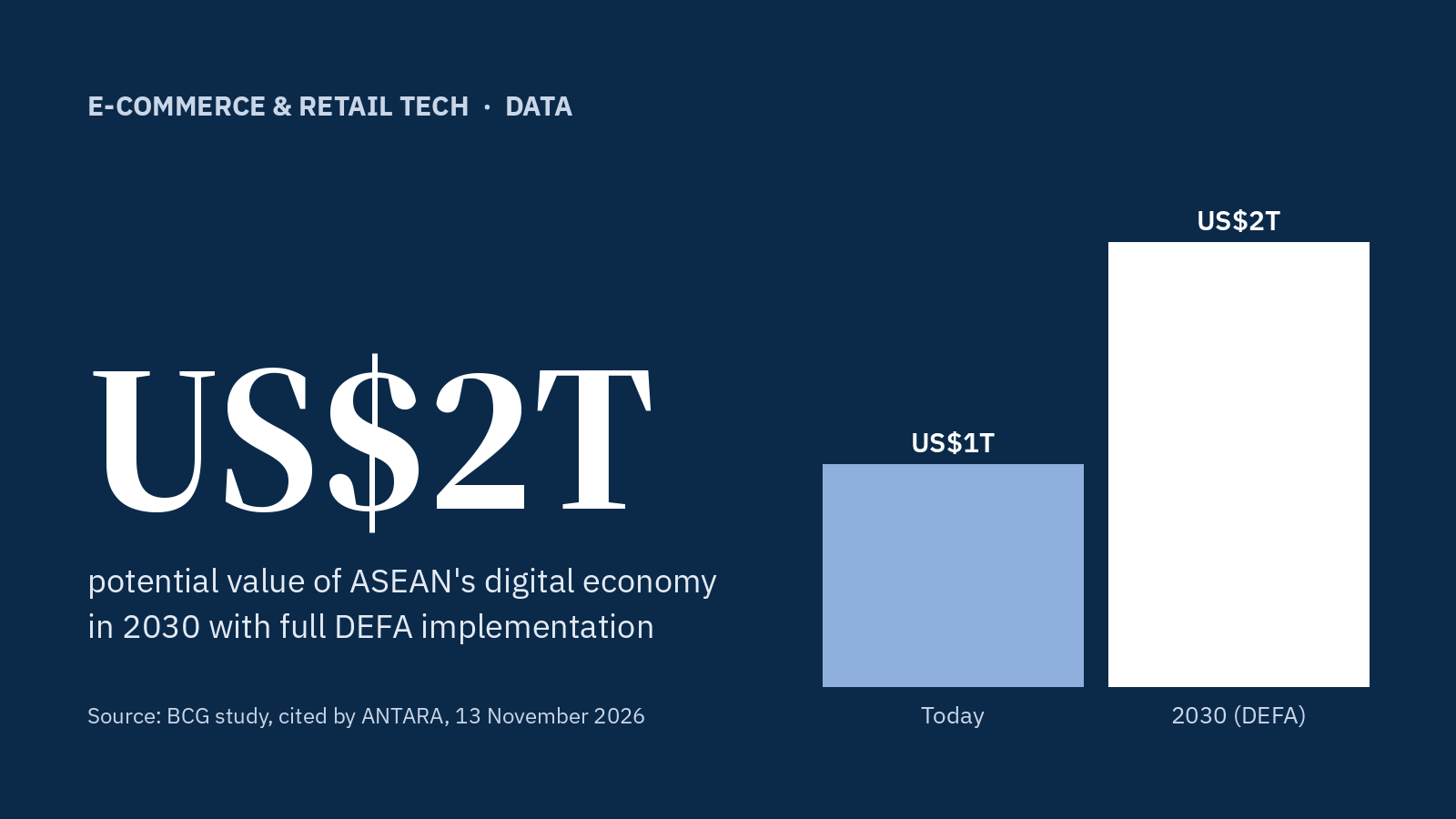
Graphic: VRI B2B Tech Asia Review. Data: BCG study, cited by ANTARA, 13 November 2026.
NEWS IN BRIEF
Compiled from media reports. Direct quotes are marked and sources are listed.
• ASEAN member states officially signed DEFA on Saturday, 14 November 2026, in Manila during the ASEAN Economic Community Council (AECC) meeting. Indonesia initiated the agreement during its 2023 ASEAN chairmanship. (ANTARA)
• DEFA is described as ASEAN's first standalone, legally binding digital economy agreement. It covers digital trade, cross-border data flows, electronic payments, cybersecurity and artificial intelligence. Priority projects could include digital payment systems, digital identities for businesses and electronic trade documents. (The Star)
• DEFA will replace the 2019 ASEAN e-commerce agreement, which Indonesia ratified through Law No. 4 of 2021. Indonesia will ratify DEFA through an inter-ministerial committee. (ANTARA)
• Sources differ on entry into force: ANTARA says 180 days after the last member state signs, while The Star cites Japan's Ministry of Economy, Trade and Industry (METI) as saying 180 days after signing. ASEAN aims to roll out the first projects in early 2027. (ANTARA, The Star)
• A BCG study estimates full DEFA implementation could raise the value of ASEAN's digital economy from about US$1 trillion to US$2 trillion by 2030. President Prabowo Subianto repeated the figure at the 49th ASEAN Summit on 15 November 2026. Coordinating Minister for Economic Affairs Airlangga Hartarto called the signing a strategic step. (ANTARA)
BEHIND THE NEWS
From online-store rules to digital-infrastructure rules
The 2019 ASEAN e-commerce agreement mainly governed online buying and selling. DEFA goes further: data flows, payments, business digital identity, cybersecurity and AI come under one binding framework. For companies, technology decisions such as where customer data is stored, which payment gateway runs cross-border checkout and how trading partners are verified will increasingly be judged against regional commitments, not only domestic rules.
What the news does not say: the commitments and the start date
The available sources do not yet detail specific obligations, such as exceptions for storing data in-country or how far cross-border data flows will be opened. Two sources also describe the entry-into-force date differently. For Indonesia there is an extra step: ratification through an inter-ministerial committee. The practical impact on Indonesian companies is therefore likely to arrive gradually from the second half of 2027 and depend on implementing rules. Companies should not change their data architecture on the strength of headlines alone.
The US$2 trillion figure needs careful reading
US$2 trillion is a BCG estimate that assumes full implementation, not a baseline projection. It also cannot be compared directly with the gross merchandise value (GMV) figures usually cited from the Google, Temasek and Bain reports, because the methods differ. More important for business is DEFA's flexible mechanism: countries that are ready may move first on specific initiatives. Cross-border ease is therefore likely to be uneven, with some corridors opening faster than others.
Who gains, who is squeezed
Sellers and brands that already sell, or want to sell, into other ASEAN countries, cross-border payment providers and electronic trade-document providers stand to gain most if the priority projects move ahead. On the other hand, more uniform rules also make it easier for players from neighbouring countries to enter Indonesia, the region's largest digital economy according to e-Conomy SEA 2025. Local players that have been shielded by differences in rules should watch this closely.
WHAT IT MEANS FOR YOU
For Heads of E-Commerce and CMOs
1. Map realistic ASEAN markets for online expansion in 2027–2028 and track which corridors run DEFA projects first.
2. Prepare cross-border payment options at checkout and test their costs before the regional payments framework is in place.
For CIOs, Legal and Compliance
1. Inventory customer data that flows abroad (cloud, CRM, analytics) and its current legal basis.
2. Follow Indonesia's ratification process and implementing rules; work through industry associations to give input.
3. Prepare partner-verification processes compatible with business digital identity, if such a scheme is adopted.
For technology providers
Opportunities lie in cross-border payments, electronic trade documents, business identity verification and multi-country data compliance tools. Build products that can adapt to the countries that join first.
FREQUENTLY ASKED QUESTIONS
What is ASEAN DEFA?
The Digital Economy Framework Agreement is a legally binding ASEAN digital economy agreement covering digital trade, cross-border data flows, electronic payments, cybersecurity and AI. It was signed in Manila on 14 November 2026.
When does DEFA take effect?
Sources differ: 180 days after signing according to Japan's METI, or 180 days after the last member state signs according to ANTARA. Indonesia still needs to ratify it.
Does DEFA replace the ASEAN e-commerce agreement?
Yes. DEFA replaces the 2019 ASEAN e-commerce agreement, which Indonesia ratified through Law No. 4 of 2021.
SOURCES
1. ANTARA — Indonesia siap tandatangani ASEAN DEFA pada 14 November 2026, 2026-11-13
2. The Star — Asean states sign Digital Economy Framework Agreement, which kicks in from early 2027, 2026-11-14
3. ANTARA News — ASEAN digital economy could reach US$2 trillion through DEFA: Prabowo, 2026-11-15
Quotations are used sparingly and credited to their source. Copyright in quoted material remains with each publisher. Analysis reflects the view of the VRI B2B Tech Asia Review editors.